
How to Track Strength Progress Without Weighing Yourself

Last Updated: November 7, 2026
Quick Summary
You can track strength progress without weighing yourself by logging weights lifted, reps completed, and effort for the same core exercises each week. Add body measurements, clothing fit, and progress photos taken every few weeks. These markers reveal real gains that the scale can hide.
Log weight, reps, sets and effort (1-10) for the same core exercises every session.
Retest the same lifts every four weeks under identical conditions to compare results fairly.
Take waist, hip and arm measurements every two to four weeks at marked spots.
Take front, side and back progress photos every four weeks in the same lighting.
Review your log weekly and read plateaus across a rolling four-week window.
Tracking strength without the scale?
Ace-1 Warrior helps busy adults 30-50 build a simple system that shows real progress.
Table of Contents
Most people who start strength training get stuck on the bathroom scale. They step on it every morning, see a number bounce up or down by two pounds, and decide they are failing. But the scale measures your body weight, not your strength. A person can add muscle, lose fat, and get much stronger while the number barely moves.
This guide walks through a simple system. You will learn why the scale misleads you, how to log your lifts, how to measure your body and take photos, and how often to check in. We will also cover what to do when progress slows down. Nothing here requires expensive equipment or a fancy app.
Why the Scale Misleads You on Strength Progress
Body weight is a blunt tool. It counts everything: muscle, fat, water, food in your stomach, and even the salt you ate last night. Strength is a different measure. It shows how much force your muscles can produce, and it can rise even when the scale stays flat.
Here is a common example. You start lifting three times a week and eat a little more protein. After a month, your squat has gone from 95 pounds to 135 pounds. The scale says you gained one pound. Many people assume the training is not working.
This is why we rely on performance markers instead. The most useful ones are:
Weights lifted for the same number of reps
Total reps you can complete at a set weight
Time needed to finish a workout or a set
How hard a set feels on a scale of 1 to 10
When these numbers go up over several weeks, you are getting stronger, no matter what the scale says.
How to Track Strength Progress Without Weighing Yourself for Beginners
Beginners often feel lost because they have no baseline. You cannot track progress if you do not know where you started, and you cannot compare workouts fairly if you change the test every week.
Start by picking three to five core exercises that cover the main movement patterns: a squat or leg press, a push like a push-up or bench press, a pull like a row, and a hinge like a deadlift or hip thrust. Keep the same exercises for at least four to six weeks so your numbers stay comparable.
Next, establish your baseline with a repeatable protocol rather than a one-off max attempt:
Warm up with five minutes of easy movement and two or three light sets of the first exercise.
Choose a weight you can lift for 8 to 12 reps with good form, stopping each set when you have about two reps left in the tank.
Record the weight, the reps completed, the number of sets, and an effort score from 1 to 10.
Rest the same amount between sets each time you test (for example, 90 seconds for isolation work and 2 to 3 minutes for squats and deadlifts).
Repeat the same exercises, in the same order, with the same rest periods on your next test day.
That consistency is what makes the numbers meaningful.
For beginners and people returning after a break, you may not have reliable lifting numbers yet. Use these non-scale benchmarks instead:
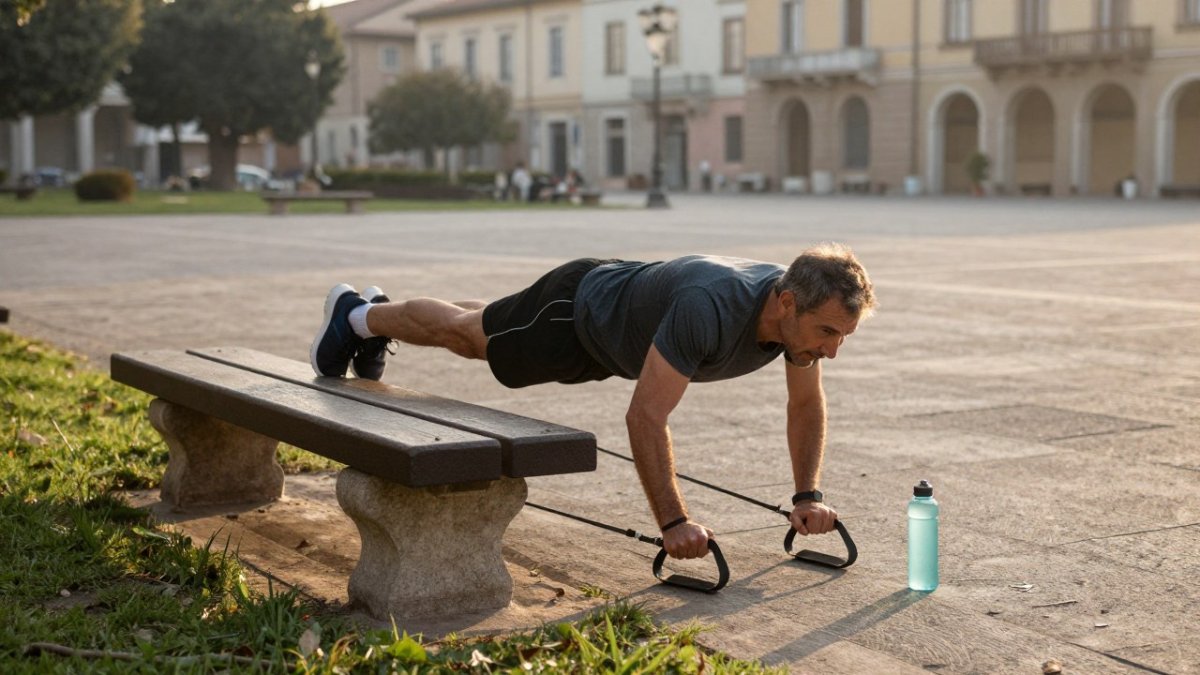
Push-up test: how many full-range push-ups you can complete before form breaks down.
Bodyweight squat test: how many controlled squats you can do in 60 seconds with good depth.
Plank hold: how long you can hold a plank with a neutral spine.
Band or dumbbell row: the heaviest weight you can row for 10 clean reps.
Stair or walking test: how many flights you can climb before your breathing changes, or how long a brisk walk takes on a fixed route.
Write these down on day one and retest them on the same schedule as your lifts. Improvement on any of them is real strength progress, even if the scale does not move.
Watch out: Changing your exercise form to lift heavier weight is a common trap. If your back rounds or your knees cave in, your numbers look better but your risk of injury goes up.
Build a Strength Training Log Template You Will Actually Use
A strength training log only works if you keep it up. The best template is the one that takes less than two minutes to fill in after a workout. Here is a simple layout you can copy into a notebook, a spreadsheet, or a notes app:
Date | Exercise | Weight | Reps | Sets | Effort (1-10) | Notes |
Mon | Goblet squat | 35 lb | 10 | 3 | 7 | Felt steady |
Mon | Dumbbell row | 40 lb | 10 | 3 | 6 | Shoulder tight |
Thu | Goblet squat | 40 lb | 10 | 3 | 7 | Good depth |
Keep the columns short. Date, exercise, weight, reps, sets, effort, and one note are enough. The effort column is especially helpful because it shows whether a weight got easier over time, even if the number stayed the same.
Review your log once a month. Look for exercises where the weight or reps rose. Those are your wins. If an exercise has stalled for three or four weeks, consider changing a variable like rest time, reps, or the weight itself.
Track Strength Progress Without Weighing Yourself at Home
You do not need a commercial gym to track strength. A home setup with a set of dumbbells or resistance bands, a sturdy bench, and a bit of floor space is enough. The key is consistency. Keeping each lift’s load and repetitions consistent makes progress easier to compare, and HYPE Fit Gear offers another perspective on recording those details.

Home tracking works well for people who are busy or who prefer to train alone. You can also use a timer to track how long your rest periods are, or count how many push-ups you can do before your form breaks down.
Here is what a typical week might look like for a home tracker:
Monday: Lower body workout, log squats and hinges
Wednesday: Upper body workout, log presses and rows
Friday: Full body workout, log the same main lifts
Repeat this pattern for four weeks, then compare your numbers from the first week and the last.
Body Measurements and Clothing Fit
Your body changes shape before the scale moves. Taking simple measurements every two to four weeks can show you what the scale hides. You need only a flexible tape measure. Measure your waist at the belly button, your hips at the widest point, and one arm or thigh.
Clothing fit is another useful signal. Notice whether your jeans feel looser at the waist or whether your shirts fit better across the shoulders. These changes often show up well before a number on a scale does.
Common mistake: Measuring at different points on your body each time. Mark your starting spots with a pen or a small piece of tape so you measure the same place every time.
Progress Photos Taken Consistently
Photos are the most honest record of change, but only if you take them the same way each time. Stand in the same spot, with the same lighting, wearing similar clothes. Take a front view, a side view, and a back view. Keep your posture relaxed and natural.
Take photos every four weeks. Store them in one folder and do not look at them every day, because small changes are easy to miss when you see yourself constantly. Compare your first photo with your most recent one after two or three months.
How Often to Track Strength Progress
Frequency matters more than perfection. Here is a simple schedule that works for most busy adults:
Every workout: Log your weights, reps, and effort
Every week: Look over your log and note any trends
Every two to four weeks: Take body measurements and clothing notes
Every four weeks: Take progress photos
Avoid checking your numbers every day. Strength changes slowly, and daily swings from sleep, food, and stress can distract you. Weekly reviews keep you on track without making you anxious.
Reading Plateaus and Non-Linear Strength Gains
Strength rarely rises in a straight line. You will have weeks where every lift goes up, followed by weeks where nothing moves.
A useful way to read your log is to separate short-term noise from a real trend.
Plateaus often happen for one of three reasons:
Recovery debt: poor sleep, high life stress, or too many hard sessions in a row.
Program stagnation: the same reps and weights for too long without a new stimulus.
Technique drift: small form changes that make the lift harder or easier without you noticing.
When progress stalls for three to four weeks, check the basics first. Are you sleeping seven to nine hours? Are you eating enough protein and total food? Are you taking rest days? A common pattern is that a single deload week, where you reduce volume or weight by roughly 40 to 50 percent while keeping the same movements, restores progress without any major program change.
If the basics are in place, change one variable at a time.
Also remember that strength can improve even when reps stay the same.
Watch out: Treating every flat week as a plateau and adding weight or volume to fix it can turn a normal dip into an overuse injury.
For a deeper look at rebuilding strength after time away, read our guide on Can You Rebuild Strength After Years of Inactivity?
Booking Your Free 10 Minute Call to Set Up Your Tracking System
Setting up a tracking system takes a little planning, and many people find it easier with a second set of eyes. If you want help choosing the right exercises, building a baseline, and creating a log that fits your schedule, the Built After 30 Program gives you a structured plan to follow. You can also book a free 10-minute consult to talk through your goals and get personal guidance on where to start.
If you train in the Toledo area, one-on-one personal training in Toledo, OH offers hands-on help with tracking progress in person. Prefer to work remotely? Our online coaching options include the same progress tracking, delivered wherever you are.
BOOK YOUR FREE 10 MINUTE CALL
Frequently Asked Questions
How can I track strength progress without weighing myself?
Log the load, reps and sets for your main lifts every workout, then compare them over four to six weeks. Rising weights at the same reps, or more reps at the same weight, are clear signs of progress. Add a waist measurement every two weeks and note how your clothes fit. Together these show whether you are getting stronger and changing shape, without relying on a scale number that moves with water and food intake.
Is there a way to track weight loss without a scale?
Yes. Waist circumference, a tape measure around the navel taken at the same time each week, tracks fat loss well. Progress photos taken in the same lighting and clothing, and how your belts and shirts fit, add useful context. Measure under similar conditions each time, such as first thing in the morning, so the readings compare fairly.
How often should I track my strength progress?
Record your lifts every training session, since that is where the data comes from. Review the trend every two to four weeks rather than every workout, because day-to-day performance changes with sleep, stress and recovery. Take body measurements and progress photos every two weeks, and set a monthly check-in to decide whether to adjust your training.
How do I know if I am getting stronger as a beginner?
Beginners usually add weight or reps quickly in the first few months. If your log shows the same weight for the same reps across several weeks, you are either fatigued or due for a small increase. Use the same exercise, tempo and range of motion each time so comparisons stay fair, and add roughly 2.5 to 5 pounds to upper body lifts or 5 to 10 pounds to lower body lifts when you hit your target reps for all sets.


Comments