
How to Stay Fit While Traveling Without a Gym

Last Updated: November 21, 2026
Quick Summary
To stay fit while traveling, plan three anchors before you leave: one 15-minute no-equipment workout you will actually do, a daily step floor, and one food rule like protein at every meal. Two to three short sessions a week plus daily walking can help maintain your fitness.
Run the hotel-room circuit three times through with 45 seconds rest between rounds, about 15 minutes total.
Leave two reps in the tank on every set so you are not too sore to repeat the workout.
On trips of four weeks or more, add one rep to each set every week for progressive overload.
Get up once an hour on flights when the seatbelt sign is off to roll your ankles and stretch your calves.
Swap exercises for injuries rather than stopping: use glute bridges and sit-to-stands for knee pain.
Tired of losing fitness every trip?
Personalized coaching that builds travel-proof routines around your real schedule.
Table of Contents
Why Travel Wrecks Your Routine and How to Plan Around It
Travel breaks routines because it removes the three things that hold a fitness habit together: a fixed schedule, familiar equipment, and a normal meal pattern. The fix is not discipline. It is planning the week before you leave. For practical advice on building habits that stick, see our guide to building habits that stick.
Travel is one of the most common reasons a fitness plan falls apart. The pattern is predictable.
Here is what most guides get wrong. They tell you to "find time" during the trip. There is no time to find. You have to decide before you go.
Plan around three anchors:
One short workout you will actually do. Pick it in advance. Fifteen minutes, no equipment.
A daily step floor. A number you can hit on a travel day, not a fantasy number.
One food rule. Not a diet. A single rule, like protein at every meal.
Write those three down before you pack. That is the whole plan.
You do not need a gym to hold your ground. You need a plan that survives a change of address.
Travel Workout No Equipment: Bodyweight Routines for Any Hotel Room
A travel workout with no equipment works because bodyweight training loads your muscles through full ranges of motion without a single piece of gear.

The American College of Sports Medicine physical activity guidelines recommend adults strength train at least twice a week. Bodyweight work counts. You do not need iron to check that box.
Most travel-fitness guides hand you one circuit and stop. That is where they fail, because a weekend trip, a two-week vacation, and a four-hour layover need different plans.
The 15-Minute Hotel-Room Circuit
Run this circuit three times through. Rest 45 seconds between rounds. Total time: about 15 minutes.
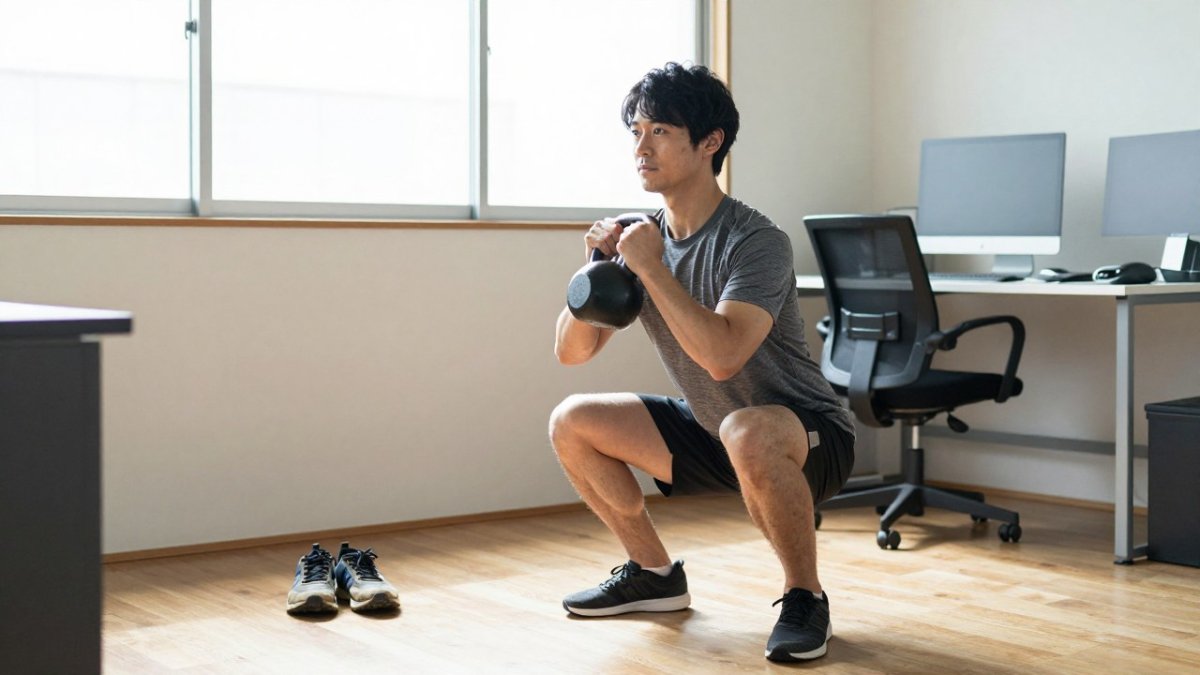
Bodyweight squats - 12 reps
Push-ups - 8 to 12 reps, knees down if needed
Reverse lunges - 8 per leg
Glute bridges - 12 reps
Front plank - hold 30 seconds
That is it. No mat required, though a folded towel helps on hard floors.
Watch out: the biggest mistake is going too hard on day one of a trip and being too sore to repeat it. Leave two reps in the tank on every set. You want to do this again tomorrow.
Short Layover and Travel-Day Routine (No Floor, No Change of Clothes)
You will not do push-ups in an airport terminal. You can still train. This five-minute sequence is built for a gate area, a jet bridge wait, or a rest-stop parking lot, and it needs nothing but a wall and a chair.
Wall push-ups - 10 reps, hands at chest height
Chair sit-to-stands - 10 reps, slow on the way down
Standing calf raises - 15 reps
Seated marches - 20 total, alternating knees
Standing hip hinges - 10 reps, hands on hips
Run it twice. It is not a strength session; it is a circulation and activation break that keeps a travel day from becoming a zero day.
Trip-Length Programming: What to Actually Do Each Day
The circuit above is a tool, not a plan. Here is how to schedule it based on how long you are away. The logic is simple: short trips protect the habit, medium trips maintain strength, and long trips need a small amount of progression or you will come home weaker.
Trip Length | Strength Sessions per Week | Session Format | Add-On |
Weekend (2-3 days) | 1 | 15-minute circuit, 2 rounds | Daily walk |
1 week | 2 to 3 | 15-minute circuit, 3 rounds | Daily step floor |
2 to 3 weeks | 3 | Circuit plus band work | One longer walk or hike |
4+ weeks | 3 | Circuit plus band work, add 1 rep per set each week | Weekly active sightseeing day |
On a trip of four weeks or more, add one rep to each set every week. That is the simplest form of progressive overload available without equipment, and it is enough to hold strength rather than just slow the decline. Do not chase soreness. The goal is showing up three times a week, not crushing one session. Keeping that steady rhythm matters more than the setting, whether you are fitting in a short session between plans or passing Launceston Squash Centre on the way to your next stop.
Keeping Strength and Muscle on Longer Trips
On trips of one to two weeks, a few short sessions a week can help you maintain strength. You are protecting what you built, not chasing new records.
For trips longer than two weeks, add one thing: a single resistance band. It weighs almost nothing and turns rows and presses back on the menu.
Band rows - 12 reps
Band chest press - 12 reps
Band pull-aparts - 15 reps
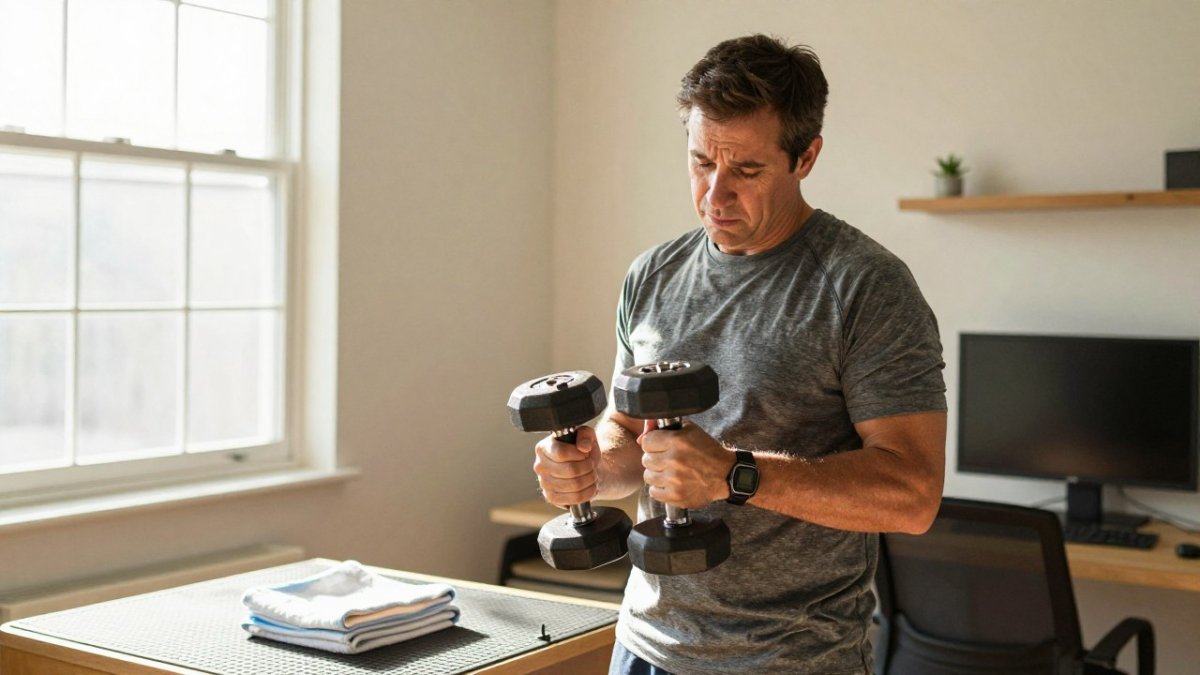
Two rounds, twice a week, alongside your circuit. If you have access to a hotel gym, swap the band work for dumbbell rows and presses at a weight you could do 12 to 15 times, and keep the bodyweight circuit as your warm-up.
Want more short routines you can rotate through the week? Browse our 9 Best 20 Minute Strength Workouts for Parents.
How to Stay Fit While Traveling for Work
Work travel is the hardest case, because the trip is not yours. Meetings run long, dinners run later, and the hotel gym is a rumor. So the plan has to be small enough to survive a bad day.
Here is one way to structure a work trip:
Morning: 10 minutes of bodyweight work before your first call. Set the alarm 15 minutes earlier.
During the day: take the stairs, walk between sessions, and stand during calls.
Evening: a 15-minute walk after dinner. This doubles as recovery and a mental reset.
On a work trip, the realistic goal is to avoid losing ground. A short workout, a walk, and a step floor can help with that.
Fitness Strategies for Long Flights and Road Trips
Long travel days are where most people write off the whole day. Don't. Movement on a travel day is about circulation, not calories.
On a flight, get up once an hour when the seatbelt sign is off. The CDC guidance on blood clots and travel notes that long periods of sitting raise clot risk, and moving your legs helps.
On a road trip, treat every fuel stop as a mini workout. Five minutes of walking, ten squats, and a stretch. Three stops adds up to real movement.
How to Stay Fit on Vacation Without Skipping the Fun
Vacation fitness is not about squeezing in workouts between activities. It is about making the activities count.
Build your days around movement you would do anyway:
Walk the city instead of taking the train
Hike a trail instead of a bus tour
Swim at the beach or hotel pool
Rent bikes for a half day
Active sightseeing covers cardio, steps, and fun at once. One short strength session every other day keeps your muscle maintenance on track.
How Often Should I Exercise While Traveling?
Two to three short sessions a week can help maintain fitness while traveling. Adding daily walking may help you hold your strength and cardio base.
Frequency often matters more than length. Three short sessions you repeat are easier to keep than one long session you do not.
A simple weekly target:
Trip Length | Strength Sessions | Daily Steps | Focus |
Weekend | 1 | 7,000+ | Hold the habit |
1 week | 2 to 3 | 7,000+ | Maintain strength |
2+ weeks | 3 | 8,000+ | Add band work |
If you are rebuilding after time off, our guide on whether you can rebuild strength after years of inactivity covers how to start without overdoing it.
Eating Well and Staying Hydrated on the Road
Restaurant meals and airport food make healthy eating hard, but not impossible. The trick is a small set of rules you can apply anywhere.
Protein first. Order the chicken, fish, eggs, or beans before anything else.
One plate, no seconds. Portion control beats willpower.
Water before every meal. Travel dehydrates you, and thirst often reads as hunger.
Pack snacks. Nuts, jerky, and fruit beat the airport kiosk.
Dietary restrictions can make this harder, but a plan can still work. Many restaurants will prepare plain protein and vegetables if you ask. Carry a backup snack so a limited menu never becomes a skipped meal.
If nutrition is the part you keep struggling with, our nutrition coaching helps you build meal rules that travel with you.
Adapting Your Plan for Injuries, Accessibility Needs, and Different Fitness Levels
Every travel plan needs a version for the body you actually have. Injuries, limited mobility, and low fitness levels are not reasons to skip the trip's workouts. They are reasons to change the exercises.
Swap, don't stop:
Knee pain: replace lunges with glute bridges and sit-to-stands
Back issues: use incline push-ups and dead bugs instead of planks
Shoulder pain: do band pull-aparts and wall push-ups
Limited mobility: do seated marches, chair squats, and band work from a chair
Starting from scratch: begin with one round of the circuit, not three
A common mistake is copying a workout built for someone else's body. Start where you are. Add a round when the current one feels easy.
Book Your Free Call and Build a Travel-Proof Plan
The hardest part of staying fit while traveling is not the workout. It is building a plan that bends when your schedule does.
That is what we do at Ace-1 Warrior. We build simple, non-complicated fitness plans around your actual calendar, with accountability that fits your schedule.
If you want a routine that survives the airport, the hotel, and the late dinner, book your free call and we will map it out together.
Travel will always interrupt your routine. The question is whether your plan can absorb the interruption or collapse under it.
Frequently Asked Questions
How can I stay in shape while traveling when I have no equipment?
You can stay fit with bodyweight moves that need zero gear. Build a 15-20 minute circuit from push-ups, squats, lunges, planks, and glute bridges. Do each for 40 seconds, rest 20 seconds, and repeat the round three times. This covers strength training and cardio in a small hotel room. A resistance band takes up almost no suitcase space and adds pulling work for your back, which bodyweight moves alone miss.
How often should I exercise while traveling?
Aim for two to three short sessions per week on a typical trip, which is enough to maintain muscle and strength. On a busy work trip, even one 15-minute routine plus daily walking keeps the habit alive. If you are on an extended trip, follow a 3-day rotation: full-body strength, walking or hiking, then mobility and recovery. Consistency matters more than session length.
How do I stay fit while traveling for work when my schedule is unpredictable?
Attach a short workout to something that already happens, like the 10 minutes after you wake up or before you shower. Keep a travel workout no equipment routine saved on your phone so there is no planning involved. Book hotels with a fitness center or near walkable areas, and use airport time to walk instead of sitting at the gate. Small, repeatable actions beat rigid plans you abandon.
Why does traveling make my body feel so tired and stiff?
Long flights and drives keep you seated for hours, which tightens hips, hamstrings, and lower back. Cabin pressure and dry air add dehydration, and crossing time zones disrupts sleep. Counter it with hourly walk breaks, a few standing stretches at the gate, and drinking water throughout the trip. A short mobility routine of hip flexor stretches, cat-cow, and shoulder rolls before bed helps you recover faster.
Comments